Something extraordinary happens beneath the soil of every forest. While people walk along quiet trails, admiring the trees above, an entire hidden world pulses below their feet. The secret life of trees involves a vast underground network where trees communicate, share resources, and even protect each other from danger.
Sandra remembers the first time she truly understood this. She was hiking through a state park years ago, watching how the sunlight played through the canopy. A park ranger mentioned something in passing about trees “talking” to each other underground. At first, it sounded like something from a fairy tale. But as she learned more, the science behind tree communication turned out to be just as magical as the stories—and absolutely real.
Understanding how understanding connections changes our perspective applies not just to human relationships, but to the natural world too. Trees aren’t isolated individuals competing for sunlight. They’re members of complex communities that have been sharing secrets for millions of years.
Why Understanding Tree Communication Matters
A Forest That Changed Her Perspective
Walking through a forest feels different once someone learns about tree communication. Those towering oaks and maples aren’t just standing there looking pretty. They’re actively working together, sending signals through their roots, and supporting each other through hard times.
Sandra recalls visiting her grandmother’s wooded property as a child. There was one massive oak tree that seemed to rule the whole hillside. Her grandmother called it “the grandmother tree” without knowing the science. Turns out, she was onto something. Scientists now call these hub trees “mother trees,” and they play a crucial role in forest ecosystems.
The Science That’s Rewriting Forest Ecology
Here’s a statistic that changes everything: 80-90% of all plant species form partnerships with underground fungi. These aren’t random encounters. They’re deliberate, life-sustaining relationships that have evolved over hundreds of millions of years.
This discovery has completely transformed how scientists think about forests. Instead of viewing trees as competitors fighting for resources, researchers now see them as cooperative communities. It’s like discovering that a city you thought was full of strangers is actually one big extended family.
What Is the ‘Wood Wide Web’? Understanding Mycorrhizal Networks
How Fungi Connect Entire Forests
The term “wood wide web” was coined by German forester Peter Wohlleben. Anyone who has read Peter Wohlleben’s book The Hidden Life of Trees knows the poetic way he describes these underground connections.
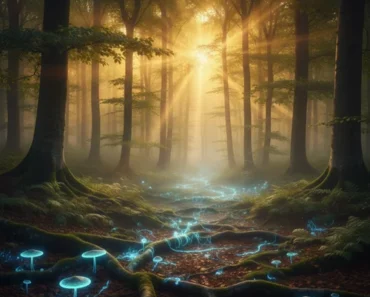
But what exactly are mycorrhizal networks? Picture this: underneath the forest floor, tiny fungal threads called hyphae wrap around tree roots like delicate fingers. These threads are impossibly thin—thinner than a human hair—but they stretch for miles. One teaspoon of forest soil can contain miles of these fungal highways.
Quick Facts About Mycorrhizal Networks
- Coverage: Fungal threads can connect dozens of trees across a forest
- Nutrient boost: Mycorrhizae contribute up to 40% of a tree’s nutrient uptake
- Phosphorus power: Absorption can improve by 100-1000% with these partnerships
- Universal: This relationship exists across nearly all tree species worldwide
The Symbiotic Relationship That Powers Tree Life
Nothing in nature is free. Trees and fungi have worked out a deal that benefits both parties. Trees are excellent at photosynthesis—turning sunlight into sugar. Fungi are excellent at extracting minerals from soil. So they trade.
Trees send 10-30% of their photosynthesized sugars down to their fungal partners. In return, fungi deliver nitrogen, phosphorus, and other nutrients that trees struggle to absorb on their own. It’s a business partnership that has been running successfully for about 450 million years.
How Trees Actually Communicate: 5 Fascinating Mechanisms
Trees don’t talk like people do. They don’t have voices or brains. But they communicate in ways that are just as effective—and sometimes more efficient than human communication.
1. Chemical Signals Through Root Networks
When a tree gets attacked by insects or disease, it doesn’t suffer in silence. It sends chemical distress signals through the fungal network. Other trees pick up these signals and can prepare their own defenses before the threat reaches them.
Research from the University of British Columbia, led by scientist Suzanne Simard, has documented this communication in stunning detail. Her work, which includes over 200 peer-reviewed articles, shows that trees actively share information about threats.
2. Sharing Nutrients and Water Underground
This is where tree communication gets almost heartwarming. Older trees don’t just hoard resources. They actively share carbon, nitrogen, and water with younger trees struggling in the shade.
Simard’s research found that some trees have fungal connections to 19 or more neighboring trees. Through these connections, they can send life-saving resources to trees in need.
3. Warning Signals About Pests and Disease
A 2013 study published in Ecology Letters found something remarkable. Pine trees that received warning signals through underground networks activated their pest defenses faster than trees without network connections. They were essentially tipped off about incoming danger.
4. Airborne Chemical Messages
Trees don’t rely solely on underground communication. They also send messages through the air using volatile organic compounds (VOCs). When a tree gets damaged, it releases chemicals that neighboring trees can detect. Those neighbors then ramp up their own chemical defenses.
This is why forests often smell so strongly after storms or when trees are being cut. Those scents are partly distress signals being broadcast to the whole community.
5. Electrical Signals Through Fungal Highways
Perhaps the most mind-bending discovery: researchers have detected electrical impulses traveling through fungal networks. These signals move in patterns that some scientists compare to neural networks in animal brains.
The research is still early. But the implications are staggering. Forests might function as something like a distributed intelligence, processing information and responding to threats as a unified organism.
Mother Trees: The Forest’s Central Hubs
What Makes a Tree a ‘Mother Tree’
Not all trees are created equal in the underground network. The largest, oldest trees tend to have the most fungal connections. Scientists call these “mother trees,” and they act as hubs for the entire forest community.
Sandra’s grandmother’s oak tree comes to mind again. That tree wasn’t just old and beautiful. It was probably the communication center for the entire hillside, supporting dozens of younger trees through its vast root network.
How Mother Trees Support Younger Seedlings
Here’s where tree behavior gets surprisingly tender. Mother trees don’t just tolerate younger seedlings. They actively nurture them:
- Carbon transfers: Mother trees send more carbon to their own offspring than to unrelated seedlings
- Root adjustments: They actually change their root structure to make room for baby trees
- Priority treatment: During drought or stress, mother trees share resources with struggling youngsters
Douglas fir trees can even recognize their own kin through mycorrhizal networks. They don’t need name tags. They know family when they sense it.
The Controversy: What Science Really Says About Tree Intelligence
The Evidence For Tree Communication
The research supporting tree communication is substantial. Suzanne Simard’s work has been published in top scientific journals, including Nature Plants. Her TED talks have been viewed over 10 million times, bringing these ideas to a massive audience.
The Mother Tree Project, launched in 2015, continues to study how preserving old-growth trees benefits entire forest ecosystems. The data keeps piling up in support of tree networks.
The Scientific Skepticism and Ongoing Debate
Being honest matters here. Not all scientists agree on how to interpret this research. Some critics argue that the evidence isn’t as strong as popular science books suggest.
A 2024 analysis in Nature Ecology & Evolution questioned some claims about mycorrhizal network cooperation. Some researchers point out that “not a single field study in forests supports mature trees communicating with saplings” in the way popularized accounts describe.
The Balanced View
What can be said confidently: Trees DO form extensive underground fungal networks. Nutrients DO move through these networks. Research IS ongoing to understand exactly how this works. The “trees talking” language might be poetic shorthand, but the underlying science is real and fascinating.
What This Means for Your Garden and the Environment
Practical Applications for Home Gardeners
Understanding tree communication isn’t just cool trivia. It can actually improve how people garden. Here are some practical takeaways:
- Preserve old trees: That big tree in the backyard isn’t just shade. It might be supporting the whole garden’s underground network.
- Don’t till deeply: Aggressive tilling destroys fungal networks. Gentle soil care keeps those connections intact.
- Consider mycorrhizal inoculation: Young trees with mycorrhizae can establish 30-50% faster than those without.
- Use natural approaches to garden care to avoid disrupting beneficial fungi.
When building raised garden beds, consider what’s happening beneath the surface. Healthy soil ecosystems support everything growing above.
Anyone caring for your own plants or growing fruit trees can benefit from understanding these underground partnerships.
Why Forest Conservation Matters More Than We Knew
The mother tree research has serious implications for logging practices. When the oldest trees get cut down, it doesn’t just remove one tree. It potentially damages the communication network for the entire area.
Climate change makes this even more important. Interconnected forests may be more resilient than fragmented ones. Trees that can share resources through networks might survive droughts and heat waves better than isolated trees.
Frequently Asked Questions
Can all trees communicate with each other?
Most tree species can participate in mycorrhizal networks, though communication happens most effectively between trees of the same species. Different tree species sometimes share the same fungal partners, allowing for cross-species resource sharing.
How far can tree communication travel?
Fungal networks can span entire forests. Research has found connections between trees hundreds of feet apart. The exact limits aren’t fully understood, but the networks are far more extensive than scientists originally imagined.
Do trees feel emotions?
Trees don’t have brains or nervous systems like animals do. They respond to their environment through chemical and electrical signals, but describing this as “feeling” is probably anthropomorphizing. That said, their responses to stress and their apparent care for offspring suggest something more complex than simple mechanical reactions.
Respecting the Unseen Connections
The next time someone walks through a forest, they might see it differently. Those trees standing quietly aren’t alone. They’re connected to hundreds of neighbors through an invisible web of communication and support.
Sandra thinks about her grandmother’s old oak tree every time she learns something new about forest networks. That tree wasn’t just beautiful. It was a community leader, a mother to seedlings, and a vital hub in an underground world that remained hidden for centuries.
The secret life of trees reminds everyone that the most important connections often happen out of sight. In forests and in life, what happens underground matters just as much as what everyone can see.